
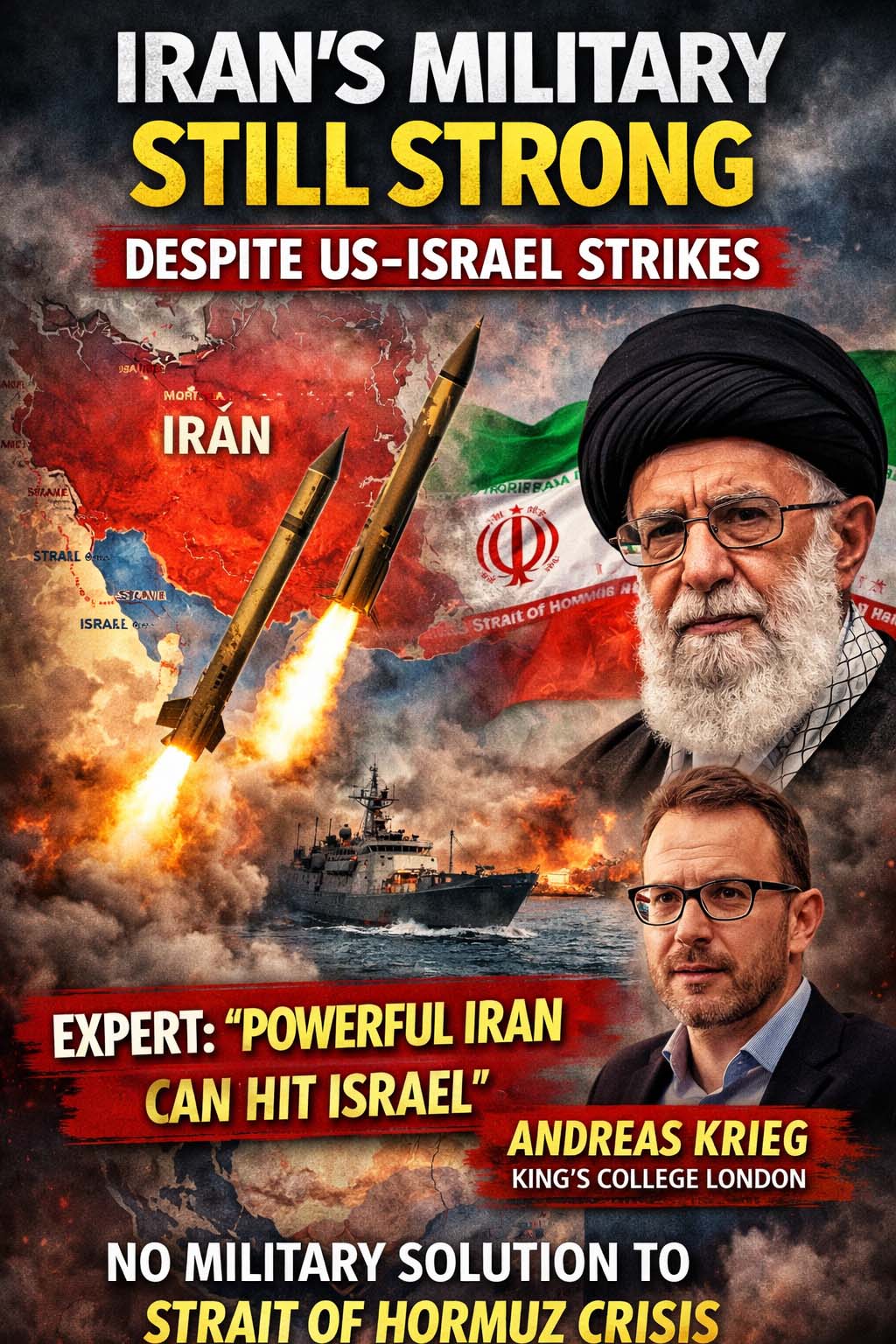
Iran’s Military Capabilities Remain Significant and Sophisticated: Analyst
April 2, 2026 — As the US-Israel military campaign against Iran enters its second month, experts caution that Tehran’s remaining military assets are still formidable, contrary to some optimistic assessments from Washington.
Andreas Krieg, a senior lecturer at the School of Security Studies at King’s College London, assessed that Iran has preserved much of its advanced weaponry despite sustained strikes. “Iran’s remaining military capabilities are still quite significant,” Krieg stated. He noted that Tehran has maintained some of its most sophisticated systems, allowing it to continue projecting power across the region.
“We’re nowhere near the situation where Iranians are unable to fire projectiles into the Gulf, or even into Israel,” Krieg explained. In fact, he added, Iran is “actually able to hit targets much more precisely” now, partly because of the degradation of regional air defense systems amid the ongoing conflict.
This assessment comes as Iran continues to launch missile barrages toward Israel and maintains pressure on shipping and targets in the Gulf area. US President Donald Trump claimed in a national address on Wednesday that American and allied forces are close to completing their primary objectives, including degrading Iran’s missile capabilities and nuclear program, and suggested major operations could wind down within two to three weeks. However, analysts like Krieg highlight that Iran retains meaningful retaliatory capacity.
Challenges in the Strait of Hormuz
The conflict has severely disrupted the Strait of Hormuz, a critical chokepoint responsible for roughly one-fifth of global oil trade. Iran’s actions have led to reduced shipping traffic, higher insurance costs, and market uncertainty, creating broader economic ripple effects.
Krieg emphasized that reopening the strait cannot be achieved through military means alone. “There is no military way to force this gate open,” he said. “Any sort of solution has to be a diplomatic one … with or without the Americans.”
He pointed out that European countries and the UK have begun to recognize the limitations of relying solely on US leadership in the region. The problem, according to Krieg, extends beyond direct naval control—it involves restoring confidence among shipping companies, insurers, and markets. Sporadic Iranian missile or drone activity is enough to keep uncertainty high, and such confidence can only be rebuilt through sustained diplomacy rather than force.
Broader Context of the Conflict
The war, which began on February 28, 2026, with large-scale US and Israeli strikes on Iranian military sites, command structures, and infrastructure, has seen both sides exchange significant blows. Iran has responded with widespread missile and drone attacks on Israeli targets, US bases, and interests in Gulf nations, while leveraging asymmetric tactics to raise the economic and political costs for its adversaries.
While the US and Israel have reported successes in degrading parts of Iran’s air defenses, missile production facilities, and leadership targets, Krieg and other observers note that Iran’s decentralized and resilient military architecture—designed for prolonged attrition—has allowed it to sustain operations. Tehran has signaled it will not halt its disruptions or accept a ceasefire while strikes on its territory continue.
As global energy markets remain volatile and calls for de-escalation grow, the coming weeks will test whether military pressure can force a resolution or if, as Krieg suggests, a diplomatic path involving multiple international actors becomes necessary. Trump has indicated the US may step back from direct involvement in securing the Strait of Hormuz, shifting responsibility to nations that depend on the waterway for energy supplies.
The situation remains fluid, with potential for further escalation or a negotiated pause depending on battlefield developments and backchannel talks.