
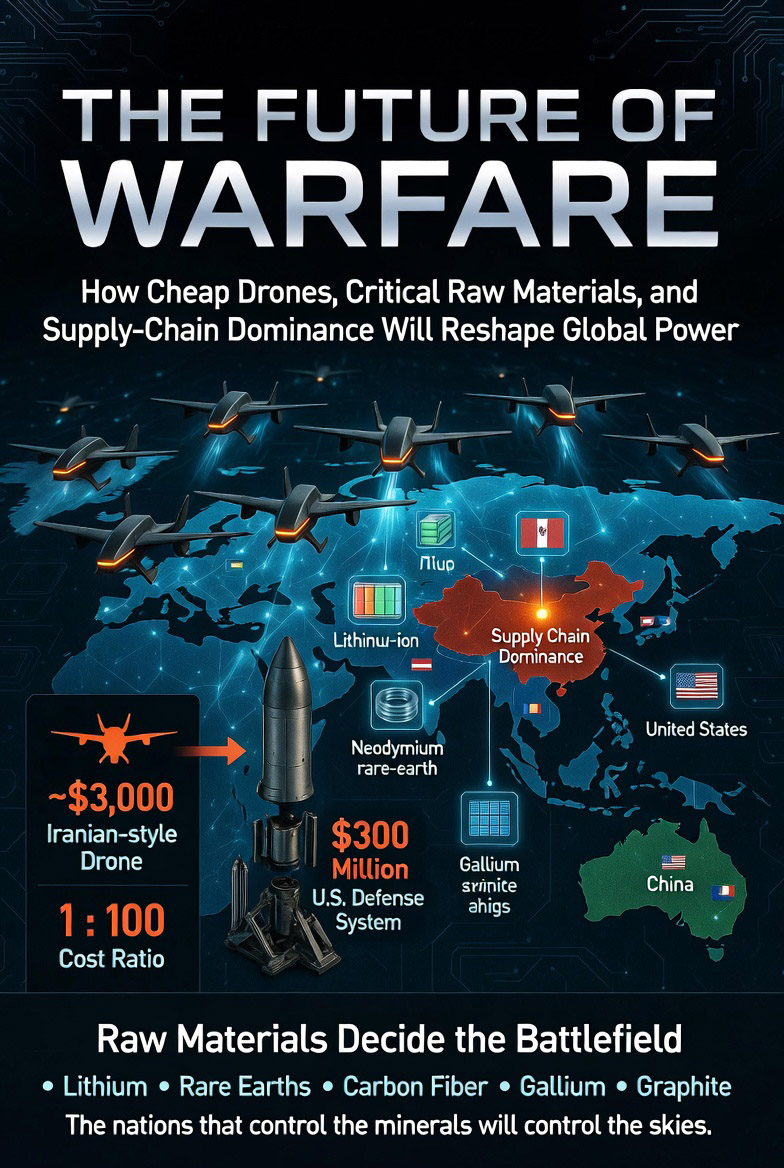
The ongoing conflicts involving Iran have exposed a stark new reality in modern warfare: asymmetry is no longer just a tactical advantage—it is becoming the defining economic and strategic calculus of conflict. In recent engagements, Iranian-designed Shahed-series drones, costing roughly $20,000–$50,000 each (with basic variants reportedly as low as a few thousand dollars in component terms), have repeatedly forced the United States and its allies to expend multimillion-dollar interceptors. A single Patriot missile can cost over $3 million; broader air-defense systems run into the hundreds of millions. The cost ratio often favors the attacker by 10:1 or more, sometimes reaching 60–70:1. U.S. officials have confirmed the capture and reverse-engineering of Iranian Shahed-136 drones, leading directly to American replicas like the LUCAS loitering munition (priced around $35,000). This is not merely a footnote in the Iran conflict; it signals a profound shift in how wars will be fought, funded, and won in the coming decades.
From an economic lens, this asymmetry turns traditional defense spending on its head. Expensive, exquisite platforms (manned aircraft, advanced missile systems) are being overwhelmed by swarms of low-cost, attritable unmanned systems. The question is no longer just “who has the better technology,” but “who can produce and sustain the most drones at the lowest cost—and who controls the raw materials that make them possible.” Nations that secure abundant access to these materials, master resilient supply chains, and scale production will emerge as the new power brokers in global security and economics.
The Raw Materials That Will Decide Tomorrow’s Battlefields
Military drones—whether small quadcopters for reconnaissance or long-range loitering munitions like the Shahed—rely on a precise cocktail of advanced materials. NATO’s recently published list of 12 defence-critical raw materials captures the essentials: Aluminium, Beryllium, Cobalt, Gallium, Germanium, Graphite, Lithium, Manganese, Platinum, Rare Earth Elements, Titanium, and Tungsten. Drone-specific applications amplify their importance.
- Structural airframe and composites: Carbon-fiber-reinforced polymers (CFRP) provide the lightweight strength that extends range and payload. Aluminium and titanium alloys, magnesium, scandium, and tantalum deliver corrosion resistance and fatigue tolerance. Carbon fiber production capacity (currently led by Japan, the United States, and rapidly expanding in China) is a chokepoint; aerospace-grade material cannot be surged quickly.
- Electric motors and propulsion: Rare-earth permanent magnets (neodymium, praseodymium, dysprosium) are indispensable for compact, high-efficiency motors. Nickel superalloys, hafnium, and copper handle heat and stress in engines or hybrid systems.
- Power systems (batteries): Lithium-ion cells dominate, requiring lithium, cobalt, graphite (anode material), manganese, and nickel. China processes roughly two-thirds of global lithium and over 70% of graphite.
- Electronics, sensors, and navigation: Gallium and germanium enable high-frequency semiconductors (GaN/GaAs chips) for radar, communications, and autonomy. Beryllium offers thermal stability in precision components; indium and tantalum appear in capacitors and imaging systems.
These are not abstract inputs. Every drone used in the Ukraine conflict—on both sides—traces critical components back to these materials. A single export restriction on graphite or rare-earth magnets can halt assembly lines within weeks. China controls 70–90% of rare-earth mining and processing, 90% of sintered NdFeB magnets, and dominant shares in lithium and graphite refining. Other key holders include Australia (top lithium producer at ~50%, major rare earths and titanium), Chile (lithium), the Democratic Republic of Congo (75%+ of cobalt), and the United States (growing domestic rare-earth output).
Countries with abundant reserves or processing capacity—China above all—will not merely supply components; they will dictate terms. Nations lacking these resources face strategic vulnerability: in a prolonged conflict, the side that runs out of magnets, lithium cells, or carbon-fiber prepreg first loses air superiority.
Future Supply Chains: From Chinese Dominance to Allied Decoupling
Today, China supplies approximately 80% of the global drone market—complete systems and components alike—thanks to state subsidies, military-civil fusion, and predatory pricing that once crashed commercial drone prices by 70%. This dominance extends to dual-use civilian and military applications, creating intelligence risks (data exfiltration under Chinese law) and wartime leverage (export controls that have already affected Ukraine while sparing Russia).
The future, however, is one of deliberate decoupling and diversification. The United States’ Replicator and “Drone Dominance” initiatives aim to field hundreds of thousands of low-cost autonomous systems by 2027–2028. NATO’s defence-critical materials roadmap, the Quad Critical Minerals Initiative, and allied efforts (Australia building rare-earth processing, Japan and South Korea strengthening carbon-fiber capacity) signal a coordinated push for “trusted” supply chains. Reports from the Atlantic Council and CSIS emphasize stockpiling precursors (magnets, lithium-ion cells, carbon-fiber prepregs), coproduction with allies, and visibility into sub-tier suppliers.
Yet challenges remain formidable. Scaling semiconductor fabs for gallium-nitride chips takes years. Environmental and capital costs make magnet production hard to onshore quickly. Carbon-fiber capacity is projected to double globally by 2030, but specialty aerospace grades are limited. The economic structure of the defence industry is shifting accordingly: from a handful of prime contractors building $100-million platforms to agile ecosystems producing thousands of $10,000–$50,000 attritable drones. Market projections reflect this: the global military drone sector, valued at roughly $15 billion in 2024–2025, is expected to reach $22–30 billion by 2030–2035, with CAGRs of 7–9%. AI integration, swarm tactics, and autonomy will drive much of the growth.
Economic Power and the New Defence Industrial Calculus
Nations that combine raw-material abundance with manufacturing scale will wield outsized influence. China’s current position already allows it to export drone technology at low cost while retaining strategic leverage. Emerging players—Turkey (Bayraktar series), Iran (Shahed family), and potentially India or Brazil—demonstrate that low-cost production plus material access can transform middle powers into exporters.
Economically, this creates new dependencies. Traditional Gulf oil economies, previously central to energy security, may face relative decline if drone swarms reduce the relevance of expensive manned air forces and naval assets. Conversely, countries investing in critical-minerals processing (Australia, Canada) or drone assembly (Poland, Taiwan) position themselves as indispensable allies. Global investment in military technologies is surging: defence budgets worldwide exceed $2 trillion annually, with drone-specific programs drawing billions in venture capital, public-private partnerships, and procurement (e.g., U.S. Army scaling FPV and loitering munitions).
The defence industry’s economic structure is bifurcating—high-end stealth platforms for peer conflict versus mass “drone meat” for attrition warfare. The winner will be the side that masters industrial resilience as much as battlefield tactics.
Political and Geopolitical Implications: A New World Order?
The rise of drone warfare carries profound political ramifications. It democratizes lethal air power: non-state actors, sanctioned regimes, and smaller nations can now impose costs on superpowers at minimal expense. Proliferation risks escalate—cheap designs spread rapidly via reverse engineering or black-market components. Ethical and legal questions multiply: autonomous swarms blur accountability; civilian infrastructure becomes vulnerable to saturation attacks.
Geopolitically, supply-chain security becomes a core element of deterrence. A nation cut off from rare-earth magnets or lithium cells cannot sustain drone operations in a protracted war. This elevates mineral-rich or processing-dominant states in alliances. China’s “drone diplomacy” (sales plus data leverage) extends influence; Western responses—bans on Chinese systems, allied Replicator programs—aim to counter it.
Economically, the calculus behind wars shifts toward cost imposition and industrial endurance rather than decisive kinetic victory. Conflicts become wars of attrition not just on the battlefield but in factories and mines. For global politics, this means new fault lines: material alliances (Quad, AUKUS Pillar II) versus resource leverage by autocratic suppliers.
Conclusion: Securing the Materials That Secure the Future
The Iran conflict’s drone lessons are a harbinger. Wars of the future will be fought—and won—by those who control the lithium in batteries, the neodymium in motors, the carbon fiber in airframes, and the gallium in chips. Countries with abundant raw materials or the foresight to secure diversified supply chains will not only project military power but also wield economic influence on a scale comparable to oil in the 20th century.
The strategic imperative is clear: nations must invest aggressively in domestic and allied processing capacity, stockpile critical precursors, and integrate industrial resilience into doctrine. Failure to do so risks ceding the skies—and with them, strategic autonomy—to whoever masters the drone economy first. In this new era, raw materials are not just inputs; they are the raw power shaping global politics, economics, and the very nature of warfare. The nations that understand this today will define the battlefield—and the balance sheet—of tomorrow.