
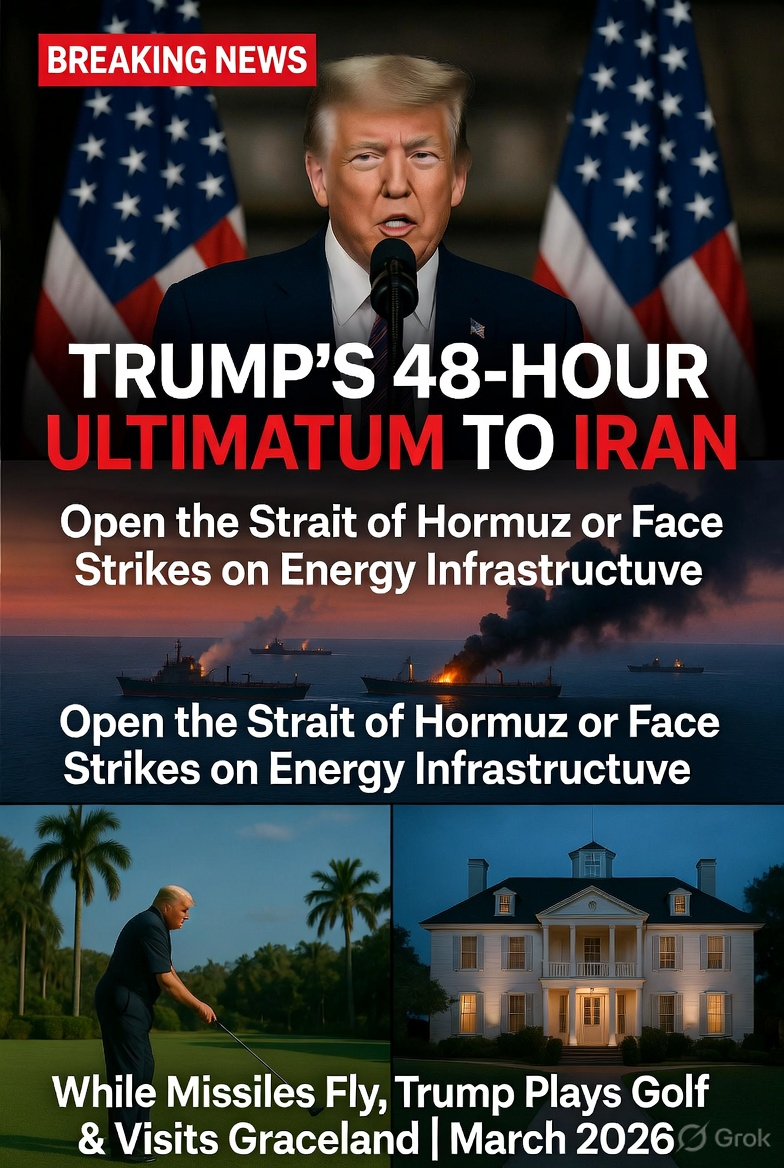
The United States is currently deeply engaged in the ongoing war against Iran. However, President Donald Trump’s actions and statements over the past several days have reflected a mix of diplomatic maneuvering, shifting positions, and occasional unconventional behavior.
On Friday, March 20, President Trump stated that the U.S. war with Iran was “winding down.” By Saturday evening, March 21, he issued a firm 48-hour ultimatum to Iran: fully open the Strait of Hormuz to international shipping, or face new American strikes. He warned that failure to comply would result in U.S. attacks on Iranian energy infrastructure, potentially plunging parts of the country into darkness.
The very next day, Trump spent time playing golf and relaxing at his Mar-a-Lago resort in Florida.
By Monday morning, March 23, as global markets faced significant pressure, Trump announced that the United States was engaged in “very good and productive” or “constructive” discussions with Iran. Later that day, he traveled to Memphis, Tennessee, where he delivered a speech before visiting Graceland—the historic former home of rock and roll legend Elvis Presley.
Trump’s Ultimatum to Iran
Throughout this period, U.S. and Israeli airstrikes on Iranian targets have continued, while Iran has responded with missile and drone attacks on U.S. military assets, Israeli territory, and American partner nations in the Middle East. Limited shipping has persisted through the Strait of Hormuz, but under heightened risk and disruption.
Trump’s Saturday night ultimatum was particularly direct and forceful. He warned that if Iran did not immediately restore unrestricted international navigation through the Strait of Hormuz, the United States would strike and “obliterate” key Iranian power plants and energy infrastructure, beginning with the largest facilities.
Iran responded defiantly, stating that any such U.S. attack on its energy infrastructure would trigger Iranian retaliation against energy and water supply systems across the Gulf region, including facilities belonging to U.S. allies.
This sequence of events highlights the unpredictable and fast-moving nature of the conflict. While Trump has alternated between signaling de-escalation, issuing strong threats, and claiming progress in talks, the military exchanges between the U.S., Israel, and Iran continue, with major implications for global energy markets and regional stability. The situation remains fluid, with both sides engaged in a high-stakes mix of military pressure and diplomatic signaling.