
March 31, 2026
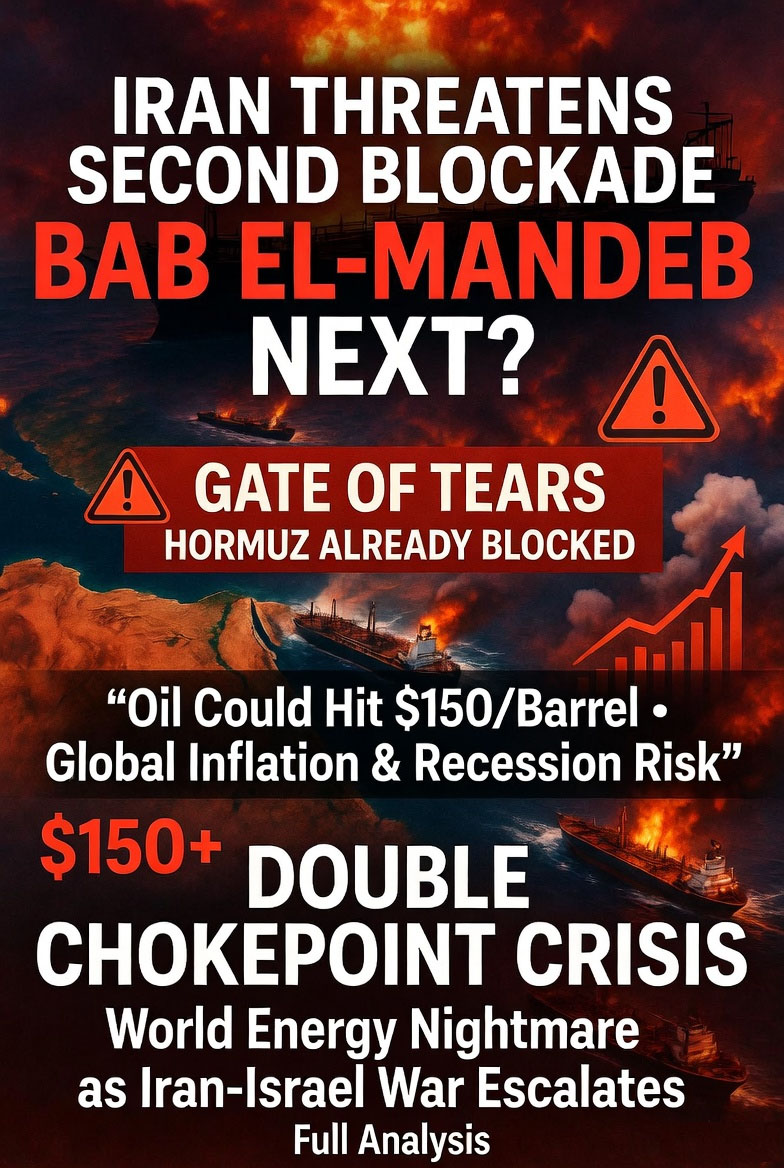
With the Strait of Hormuz already effectively sealed by Iran’s Islamic Revolutionary Guard Corps (IRGC), global oil markets are in full panic mode — prices have surged past $116 per barrel for Brent crude, U.S. gasoline has topped $4 a gallon, and supply chains are reeling. Now, fresh threats from Iran and its Houthi allies point to a second critical chokepoint: the Bab el-Mandeb Strait, known as the “Gate of Tears.” If Iran moves to ban or disrupt traffic through this narrow Red Sea passage, the world could face an unprecedented double blockade with catastrophic consequences for energy prices, inflation, and global trade.
The Bab el-Mandeb Strait, located between Yemen, Djibouti, and Eritrea, serves as the southern gateway to the Red Sea and the Suez Canal. Before the current Iran-Israel-U.S. war, it carried approximately 9.3 million barrels of oil per day — nearly 12% of global seaborne oil trade — along with significant volumes of liquefied natural gas (LNG) and container cargo linking Asia, Europe, and the Middle East.
Iran has already signaled it could activate this second front. Houthi militants, backed by Tehran, have stepped up attacks in the Red Sea, and senior Iranian officials have hinted at broader control or outright disruption of Bab el-Mandeb if the conflict escalates further. With Hormuz traffic reduced to a trickle (only a handful of vessels transiting daily, some paying multimillion-dollar “fees” to Iran), a closure of Bab el-Mandeb would eliminate the main remaining alternative route for Gulf oil heading to Europe and Asia via the Suez Canal.
Economic Shockwaves: Oil Prices Could Explode Higher
Analysts warn that a simultaneous disruption of both straits would remove up to 30% of global oil supply from normal circulation. Even with emergency rerouting around Africa’s Cape of Good Hope, strategic reserve releases, and increased production elsewhere, the world would still face a shortfall of roughly 13 million barrels per day.
- Oil prices: Brent crude could spike to $150 per barrel or higher in a worst-case scenario, according to industry forecasts. JPMorgan analysts estimate an additional $20 per barrel from Bab el-Mandeb disruptions alone on top of the current Hormuz-driven surge.
- Global inflation: Energy costs would ripple through every sector — higher fuel prices for shipping, aviation, and trucking would drive up food, manufacturing, and consumer goods costs worldwide.
- Recession risk: Major economies could see GDP growth shaved by 2–3 percentage points in the short term, with Europe and Asia hit hardest due to their reliance on Middle East oil and the Suez route.
Broader Impacts on World Trade and Shipping
The Bab el-Mandeb is not just an oil route — it handles nearly 15% of global maritime trade, including consumer goods, electronics, and raw materials between Asia and Europe. A closure would force ships to take the much longer Cape of Good Hope route, adding thousands of miles, weeks of delay, and massive insurance premiums.
- Europe: Already facing high energy costs from the Hormuz blockade, a Red Sea shutdown would worsen natural gas and oil shortages, potentially triggering blackouts and industrial slowdowns.
- Asia: China, India, Japan, and South Korea — major importers of Gulf crude — would scramble for alternative supplies, driving up prices in the world’s fastest-growing energy markets.
- Developing nations: Countries in Africa and South Asia, already strained by high fuel costs, could face food shortages and social unrest as import costs soar.
- U.S. and Americas: While less dependent on these routes, American consumers would still feel pain at the pump, with analysts predicting gasoline prices climbing toward $5–$6 per gallon if the crisis drags on.
Shipping experts describe the combined Hormuz-Bab el-Mandeb scenario as a “nightmare” for global logistics. Container shipping rates, already elevated, could double or triple, further fueling inflation and supply chain bottlenecks reminiscent of the COVID-19 era — but far more severe.
Geopolitical Stakes and Limited Options
The U.S. and its allies have issued stern warnings to Iran and the Houthis against targeting Bab el-Mandeb, with some officials signaling possible military action to keep the strait open. However, reopening Hormuz has already proven difficult, and a second naval confrontation would stretch Western resources thin.
Alternatives like pipelines through Saudi Arabia or increased U.S. shale production offer only partial relief. Strategic petroleum reserves in the U.S., Europe, and Asia are being tapped but cannot sustain long-term disruptions.
As the Iran-Israel war enters a dangerous new phase, the potential closure of Bab el-Mandeb represents more than just another shipping headache — it could tip the global economy into a full-blown energy crisis. World leaders are now racing to prevent the “Gate of Tears” from living up to its ominous name.