
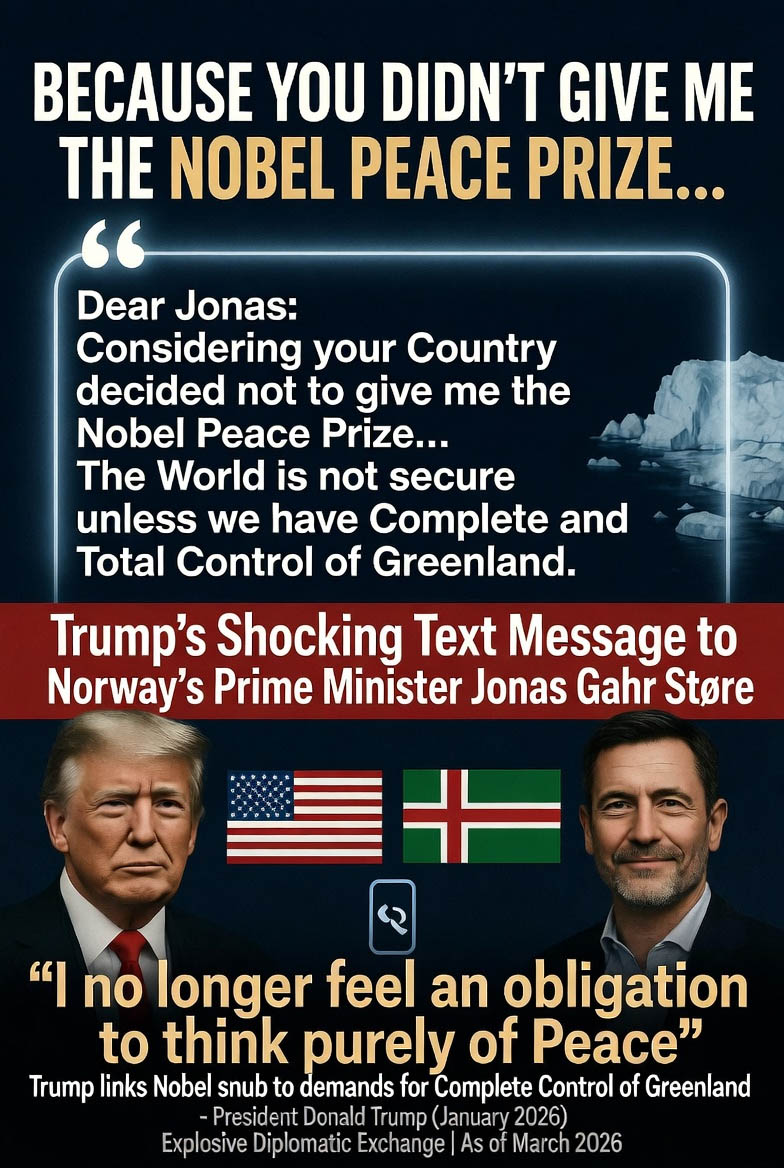
In a highly unusual diplomatic exchange in January 2026, U.S. President Donald Trump directly linked his long-standing desire for American control over Greenland to his disappointment over not winning the Nobel Peace Prize.
The message, sent via text to Norwegian Prime Minister Jonas Gahr Støre, quickly became one of the most talked-about moments of early 2026, sparking international debate, media frenzy, and tensions with European allies.
The Exact Words That Shocked Many
In response to a message from Prime Minister Støre urging de-escalation on issues including Greenland, tariffs, Gaza, and Ukraine, President Trump replied:
“Dear Jonas: Considering your Country decided not to give me the Nobel Peace Prize for having stopped 8 Wars PLUS, I no longer feel an obligation to think purely of Peace, although it will always be predominant, but can now think about what is good and proper for the United States of America. The World is not secure unless we have Complete and Total Control of Greenland.”
Trump went on to question Denmark’s historical claim over the Arctic island, arguing that it lacks proper documentation and cannot adequately protect Greenland from potential threats by Russia and China.
The Norwegian government later released the exchange, and the White House confirmed the authenticity of the message.
Context of the Statement
- Nobel Peace Prize Grievance: Trump has long believed he deserved the Nobel for his foreign policy achievements, including brokering deals in the Middle East and claiming to have helped end or prevent multiple conflicts. The 2025 Nobel Peace Prize was not awarded to him, and he has repeatedly expressed frustration over it.
- Greenland Ambitions: This is not Trump’s first interest in Greenland. During his first term, he famously proposed buying the island. In his second term, the push intensified, citing national security needs — particularly for missile defense, Arctic dominance, and countering Chinese and Russian influence in the strategically vital region.
- Tariff Pressure: Around the same time, Trump threatened new tariffs on Norway and several other European countries unless progress was made on Greenland negotiations.
Prime Minister Støre responded by clarifying that the Nobel Peace Prize is decided by an independent Norwegian Nobel Committee, not the Norwegian government, and reaffirmed Norway’s support for Denmark’s position that Greenland is not for sale.
Reactions and Fallout
The message drew sharp criticism from many quarters:
- European leaders viewed it as an aggressive and unusual mixing of personal grievances with serious geopolitical demands.
- Fact-checkers pointed out inaccuracies, including Trump’s claim of stopping “8 wars” and questions over Denmark’s legal ownership of Greenland.
- Supporters of Trump argued he was simply prioritizing “America First” and highlighting real security concerns in the Arctic.
Later in January 2026, Trump appeared to step back slightly from the most confrontational tone during appearances at the World Economic Forum in Davos, stating he did not want to use military force but still sought negotiations for U.S. acquisition or strong influence over Greenland.
Why It Matters
The episode highlights the intersection of personal politics, national security strategy, and transatlantic relations under Trump’s second term. Greenland — vast, resource-rich, and sparsely populated — holds growing strategic importance due to melting ice caps, new shipping routes, and military positioning.
As of late March 2026, the situation remains fluid, with ongoing diplomatic discussions but no final resolution on U.S. ambitions regarding the island.
This extraordinary exchange between President Trump and Norway’s Prime Minister will likely be remembered as a defining — and controversial — moment in modern U.S.-Europe relations.
Sources include official statements from the Norwegian government, reports from major outlets, and confirmations from the White House (as of March 2026). The diplomatic landscape continues to evolve rapidly.