
The U.S. Department of Justice has released new documents linked to the notorious sex offender Jeffrey Epstein. In an interview given to the FBI, a woman claimed that Epstein introduced her to Donald Trump, who then sexually assaulted her when she was a minor. These pages had not been made public earlier.
The FBI conducted four interviews related to the woman’s claims. However, the initial release only included a summary of one interview, in which the woman detailed allegations against Epstein. Questions arose about the missing three interviews. Officials have now stated that they were mistakenly labeled as “duplicates” and withheld. Upon review, this was found to be incorrect.
Accusations of Suppressing Trump’s File
U.S. opposition Democratic Party leaders are questioning the Trump administration’s handling of Epstein-related documents. They allege that the Trump administration suppressed information from the Epstein investigation that could harm Trump. A House committee has voted in favor of issuing a subpoena to Attorney General Pam Bondi, who will now have to respond in court.
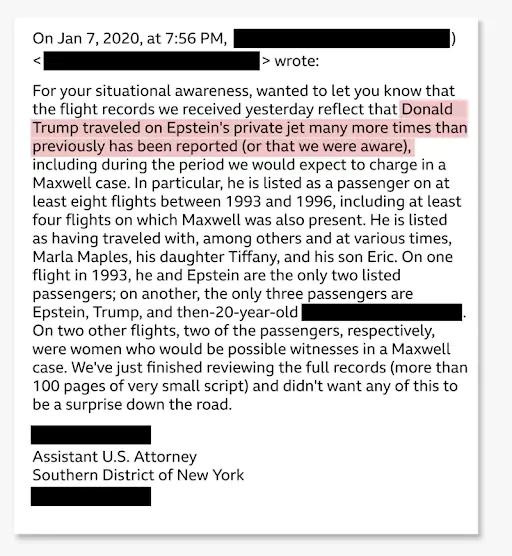
[Image: This is a picture of the email mentioning Donald Trump’s visits to Epstein Island.]
Woman’s Allegation: Epstein and Trump Sexually Assaulted Her
The woman accusing Trump gave multiple interviews to the FBI in 2019. The documents released on Thursday include details from these very interviews. According to media reports, in these interviews, the woman alleged that between the ages of 13 and 15, she was sexually assaulted by Epstein and Trump.
In one interview, the woman stated that Epstein took her to New York or New Jersey and introduced her to Trump there. She told investigators that when Trump was pressuring her for sex, she bit him. The woman also claimed that over the past several years, she and her close associates received threatening phone calls to stay silent. She believes these calls may have come from people connected to Epstein.
Trump’s Name Appears 38,000 Times in Epstein Files
Trump’s name appears more than 38,000 times in the Epstein files. Records mention 7-8 trips on Epstein’s private plane in the 1990s. He is also listed on the guest list for Trump’s Mar-a-Lago club.
The investigation has revealed that the sexual exploitation network was not limited to the U.S. Epstein had established an organized trafficking network. So far, names of wealthy individuals, leaders, and international figures from 15 countries have emerged in the Epstein files.
Trump Denies the Allegations as False
Trump has denied any wrongdoing in connection with all Epstein-related allegations. The Department of Justice had previously stated that some released documents contain “false and sensational claims” against Trump. Meanwhile, opposition Democratic leaders have accused the Trump administration of attempting to hide certain Epstein investigation details that could be damaging to Trump.
[Image: This picture from the Epstein files (File 468), which shows Donald Trump, has been removed from the site.]

Full Timeline of the Case
14-Year-Old Girl Files First Complaint
2005: 30 girls give statements in Florida. A mother in Florida filed a complaint that Epstein had sexually assaulted her 14-year-old daughter under the pretext of a massage. The investigation uncovered statements from 30 underage girls.
2006-08: Lenient Acosta, later a Cabinet Secretary. The U.S. Attorney’s Office gave Epstein a “plea deal” that spared him a federal trial. He received a light 13-month sentence and permission to work outside during the day. The prosecutor who approved this deal, Alex Acosta, later became Labor Secretary in Trump’s first term in 2017.
2009-15: Released from jail, network remains active. After the deal, Epstein stayed active. Evidence of activities linked to the “Lolita Express” private plane and his island grew in agencies’ possession, but no decisive action was taken.
2017-18: Case reopens amid #MeToo movement. Following the #MeToo movement, victims’ testimonies and investigations exposed Epstein’s influential connections.
2019: Federal arrest and suspicious death in jail. Epstein was arrested in New York on sex-trafficking charges. A month later, he died under suspicious circumstances in the Metropolitan Correctional Center, officially ruled a suicide.
2020-26: Files released under court order… Under a U.S. court order and the Epstein Files Transparency Act, 3 million pages have been released, triggering a global investigation.
Epstein Files Fallout: Is Trump’s Iran War a Desperate Diversion Tactic Amid Global Scandals?
In a whirlwind of political chaos that has gripped the United States and rippled across the globe, President Donald Trump’s administration finds itself at the epicenter of two explosive crises: the ongoing release of Jeffrey Epstein’s files, which have implicated Trump and over 1,000 influential figures in allegations of sexual misconduct and exploitation, and the sudden escalation into a full-scale war with Iran. As protests erupt across American cities demanding Trump’s resignation, questions swirl about whether the president’s declaration of war—framed as a response to “imminent threats”—is a calculated move to bury the Epstein scandal under the fog of international conflict. Adding fuel to the fire are revelations tying Indian Prime Minister Narendra Modi to the Epstein network, with unverified claims of blackmail by Trump to secure India’s neutrality in the Middle East turmoil.
This article examines the interplay between these events, the human cost of the war, and the broader implications for global stability. While the White House denies any connection between the Epstein disclosures and the military action, critics argue it’s no coincidence that airstrikes intensified just as damning documents surfaced. Israeli citizens, meanwhile, express growing unease over their country’s deep involvement in the conflict, fearing prolonged regional instability.
The Epstein Files: A Pandora’s Box of Power and Abuse
The U.S. Department of Justice (DOJ) has been steadily releasing millions of pages under the Epstein Files Transparency Act, signed by Trump himself in 2020. The latest batch, dropped on March 6, 2026, includes FBI interview summaries from a woman alleging Trump sexually assaulted her as a minor in the 1980s, after an introduction by Epstein. These files, previously withheld as “duplicates,” detail claims of abuse when the accuser was between 13 and 15 years old, including an incident where she reportedly bit Trump during the assault.
Trump’s name appears extensively in the records—far beyond initial estimates—linked to Epstein’s private jet flights, Mar-a-Lago guest lists, and a sprawling network involving figures from 15 countries. The disclosures have exposed over 1,000 powerful individuals, including politicians, business tycoons, and celebrities, in a web of organized trafficking that extended beyond U.S. borders.
Protests have surged in major U.S. cities like New York, Washington D.C., and Los Angeles since the March 6 release. Demonstrators, fueled by #MeToo echoes and anti-corruption chants, carry signs reading “Epstein’s List = Trump’s Shame” and demand impeachment proceedings. Democratic leaders have accused the Trump administration of suppressing files to protect the president, leading to a House committee subpoena for Attorney General Pam Bondi. Trump has dismissed the allegations as “false and sensational,” with the DOJ echoing that some claims may be unsubstantiated.
The Iran War: Distraction or Genuine Threat?
Just days before the Epstein files’ bombshell drop, on February 28, 2026, the U.S. and Israel launched joint airstrikes on Iran, marking the start of what Trump has called a “decisive war” against Tehran’s “malign influence.” The strikes killed Iran’s Supreme Leader Ayatollah Ali Khamenei and targeted nuclear sites, missile programs, and military infrastructure. Trump justified the action as preemptive, citing “imminent threats” to U.S. interests, though administration explanations have shifted from nuclear dangers to broader terrorism support.
Skeptics, including some in Congress, argue the timing is suspect: The war diverts media and public focus from Epstein revelations, which could derail Trump’s 2026 agenda. As one analyst noted, interest in the Epstein files “plummeted” after the war began. Trump has rejected talks with Iran, stating it’s “too late,” while escalating strikes deeper into the country. Over 1,200 Iranians have died, with U.S. casualties mounting to dozens amid retaliatory missile attacks.
The human toll raises profound questions: What is the worth of U.S. soldiers’ lives in a conflict that may serve political ends? Families of deployed troops protest, arguing their loved ones are pawns in a diversionary war. Similarly, Iranian civilians—already battered by sanctions and now airstrikes—face a humanitarian crisis, with reports of mass displacement and infrastructure collapse. Is Trump using presidential power to “destroy” Iran, or is this merely an agenda to salvage his reputation? Critics point to exaggerated threats and contradictory goals, suggesting regime change is the real aim, not just disarmament.
Israeli Dissent and Global Ripples
Israel, a key U.S. ally in the war, has framed the conflict as existential, targeting Iran’s nuclear ambitions and proxies like Hezbollah. Prime Minister Benjamin Netanyahu, a longtime advocate for striking Iran, lobbied Trump aggressively. However, not all Israelis are on board. Public polls show growing anxiety over a protracted war, with fears of spillover into Lebanon or broader escalation. Some officials warn the conflict could last months, straining U.S.-Israel ties if Trump seeks a quick exit. Religious rhetoric from both sides—U.S. troops reportedly briefed on “biblical end times”—has fueled domestic unease in Israel.
Modi’s Epstein Link and Alleged Blackmail
The scandal’s international reach includes Indian Prime Minister Narendra Modi, whose name surfaced in February 2026 Epstein releases via emails linking him to Epstein’s network during a 2017 Israel visit. Modi has denied any connection, with India dismissing the references as “trashy ruminations.” However, speculation abounds that Trump, aware of these ties, has blackmailed Modi to keep India neutral in the Iran war—perhaps leveraging arms deals or economic pressure. Indian opposition parties demand transparency, while global media highlights the silence from New Delhi amid the conflict. This has strained U.S.-India relations, with Modi’s government cautiously criticizing the war’s humanitarian impact without direct condemnation.
Date-Wise Timeline of Key Incidents
To contextualize the intertwined crises, here’s a chronological index of major events in 2026:
February 2-4: Epstein files tranche names Modi and other global leaders in emails; India and Malaysia deny links.
February 6: White House fact sheet outlines Iran’s “threats,” setting stage for military action.
February 19: Trump warns Iran of “bad things” if no deal; U.S. deploys more aircraft to region.
February 28: U.S.-Israel launch joint strikes on Iran, killing Khamenei; war begins.
March 3: Trump exaggerates Iran’s threats; protests in U.S. begin over war and emerging Epstein rumors.
March 5: House rejects war powers resolution; Iranian retaliations kill U.S. troops.
March 6: DOJ releases Epstein files with Trump assault allegations; protests intensify nationwide. Israeli strikes deepen; global reactions highlight spillover fears.
March 7-8 (Ongoing): War enters second week; U.S. strikes “deeper” into Iran; Israeli public dissent grows; unverified Modi blackmail claims circulate amid India’s silence.
Conclusion: A High-Stakes Gamble
As the Iran war rages and Epstein files continue to unravel elite networks, Trump’s strategy—whether diversionary or defensive—risks eroding U.S. credibility. The lives of American soldiers and Iranian civilians hang in the balance, potentially sacrificed for political survival. With Modi’s entanglement adding a layer of international intrigue, the world watches as this saga tests the limits of power, accountability, and human worth. If history is any guide, such tactics rarely end well for those wielding them.