
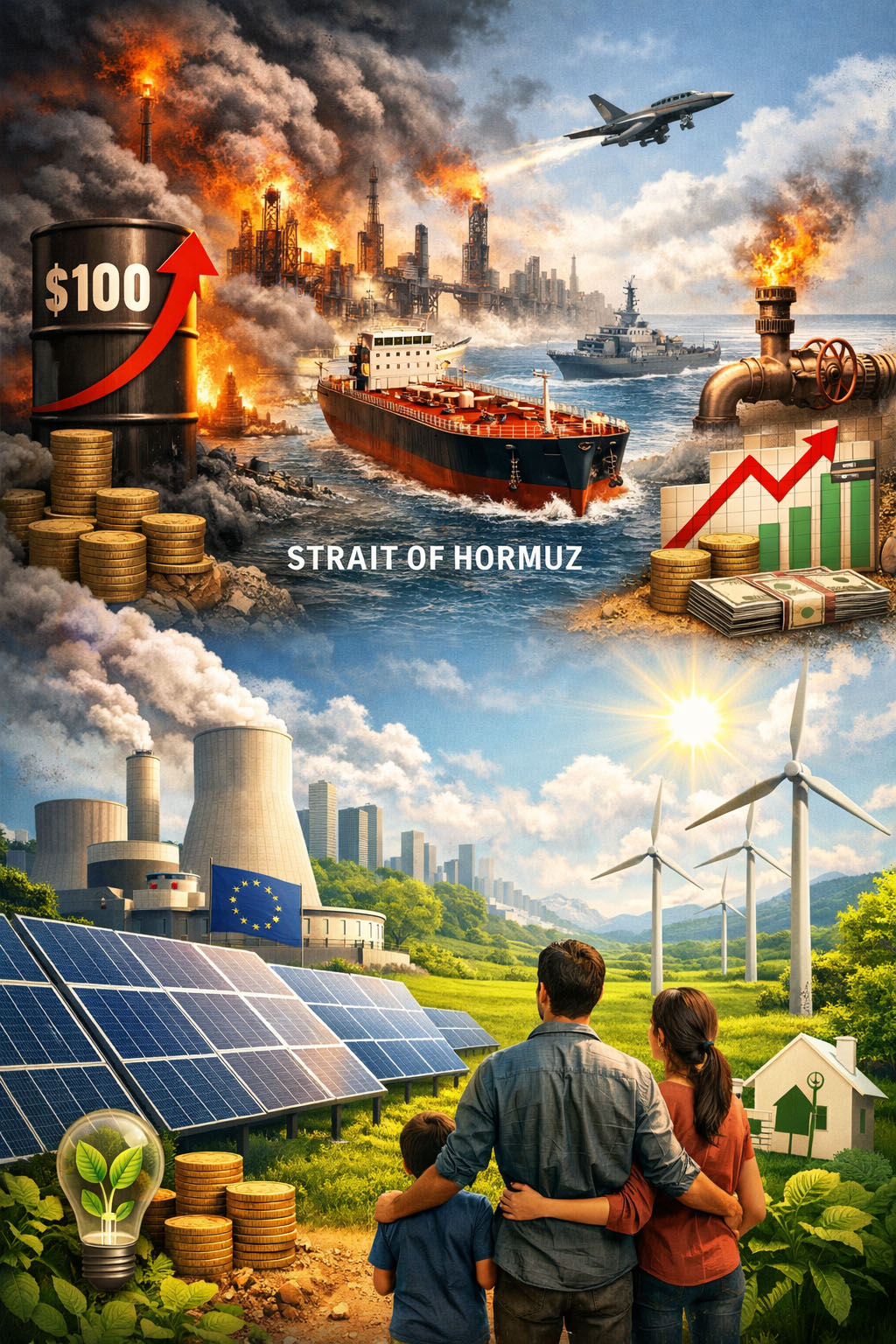
The ongoing conflict in the Middle East is dramatically illustrating the steep price of heavy reliance on fossil fuels, directly threatening national security and economic sovereignty across the globe.
Renewable energy sources offer a powerful alternative. Sunlight and wind power operate independently of fragile shipping lanes or the need for costly naval protection. They enable nations to shield themselves from international instability and reduce exposure to power-driven geopolitics.
Market chaos triggered by the war has delivered a stark reminder of how fossil-fuel dependence can destabilise economies and compromise security. The effective shutdown of the Strait of Hormuz — the narrow passage carrying roughly 20 percent of global oil and gas shipments — has sent energy prices soaring by about 50 percent in just two weeks. Benchmark crude oil has climbed to $100 per barrel.
Europe faces particular risk from sharp rises in natural-gas costs. The disruption ranks as the largest in history, cutting off supplies of jet fuel and diesel. Middle Eastern exports have halted, Asian refineries have slashed production rates, and several Asian producers have restricted or banned fuel exports to safeguard their own domestic needs.
Continued dependence on imported fossil fuels leaves economies trapped in a cycle of recurring crises. Households and industries end up absorbing the full financial impact through higher bills and reduced competitiveness.
By contrast, renewables reverse this vulnerability. They insulate economies, household budgets and business performance from sudden geopolitical shocks and wild price swings in an unpredictable world.
Governments are now racing to limit the damage. Some major Asian economies are ramping up coal output and consumption as an immediate buffer. Developed nations in northern Asia are accelerating nuclear-power programmes alongside faster renewable-energy deployment. European countries are pushing to expand the share of clean energy in their mix while weighing temporary caps on natural-gas prices to protect consumers and industry.
The message is clear: over-reliance on fossil-fuel imports keeps nations perpetually exposed to external shocks. Shifting decisively toward renewables provides the strategic independence and stability that volatile global energy markets can no longer guarantee.