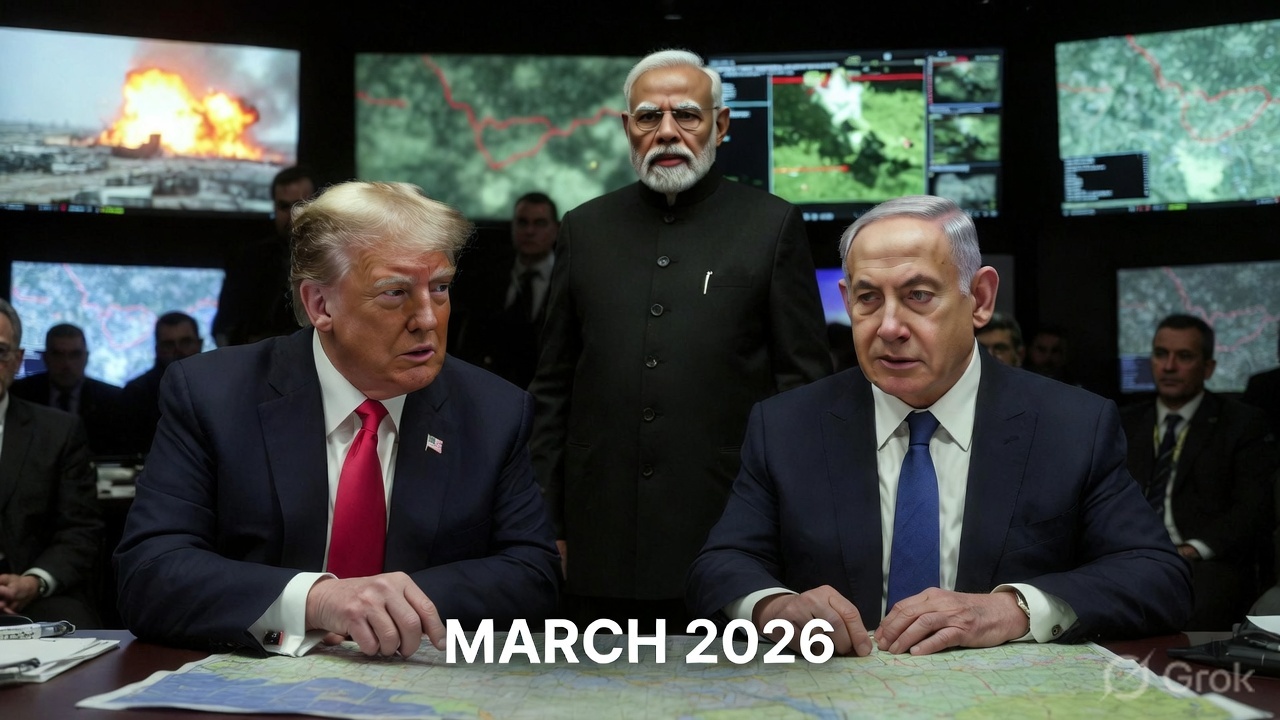
The world stands at the precipice of a major conflict, with many ordinary citizens expressing regret over recent electoral choices. As of March 2026, escalating military actions in the Middle East have fueled widespread disillusionment with elected leaders, who are accused of consolidating control over key institutions like government agencies, police forces, and judiciaries. This erosion of trust is particularly evident in nations where leaders have been criticized for prioritizing personal or national agendas over global stability. Examples include the United States under President Donald Trump, Israel under Prime Minister Benjamin Netanyahu, and India under Prime Minister Narendra Modi.
Below is a rewritten and structured version of the concerns raised, organized with dated indexing for clarity based on recent developments. This timeline incorporates verified events and statements, highlighting how these leaders’ actions have contributed to the current crisis.
Timeline of Key Events (Dated Indexing)
- October 7, 2023 – Start of Gaza Conflict: Tensions in the Middle East escalated with Hamas attacks on Israel, leading to Israel’s military response in Gaza. This marked the beginning of prolonged regional instability, with Netanyahu’s government facing international criticism for civilian casualties.
- November 2024 – U.S. Presidential Election: Donald Trump wins a second term, campaigning on “America First” policies, including tariffs and strong alliances with Israel. His inauguration on January 20, 2025, sets the stage for renewed focus on Iran and trade wars.
- January 20, 2025 – Trump’s Second Inauguration: Trump assumes office, emphasizing economic growth through tariffs and foreign policy shifts. By early 2026, his administration has imposed tariffs on global imports, contributing to economic strains worldwide.
- February 20-22, 2026 – U.S. Supreme Court Rules on Tariffs: The Court strikes down Trump’s use of the International Emergency Economic Powers Act (IEEPA) for broad tariffs. In response, Trump announces a 10% global tariff under Section 122 of the Trade Act, later raising it to 15% on February 22, 2026, citing balance-of-payments issues. This exacerbates global economic tensions, with critics arguing it risks bankruptcy for smaller nations.
- February 25-26, 2026 – Modi’s Visit to Israel: Indian Prime Minister Narendra Modi visits Israel, elevating bilateral ties to a “special strategic partnership.” Agreements cover defense, technology, and trade. Modi is not briefed on impending strikes on Iran, as the decision was finalized after his departure.

- February 28, 2026 – U.S.-Israel Strikes on Iran Begin: Joint U.S.-Israeli airstrikes target Iranian leadership, nuclear sites, and military infrastructure under “Operation Epic Fury” (U.S.) and “Operation Roaring Lion” (Israel). Supreme Leader Ali Khamenei is killed in the initial wave, along with other officials. Trump justifies the action as addressing Iran’s nuclear threat, while Netanyahu calls it a “pre-emptive attack” to remove an existential danger.
- March 1-3, 2026 – Iranian Retaliations and Escalation: Iran launches missile and drone strikes on U.S. and Israeli targets, including embassies and oil infrastructure. Explosions rock Tehran, Beirut, and other sites. The conflict spreads, with civilian casualties reported, including over 160 deaths from a strike on a school in Minab.
- March 5, 2026 – Modi’s Statement on the Conflict: Modi expresses concern over West Asia tensions, advocating for dialogue but condemning Iranian retaliatory attacks. India’s opposition criticizes this as aligning too closely with the U.S.-Israel camp, given Iran’s historical support for India on issues like Kashmir.
- March 5-6, 2026 – Epstein Files Release: The U.S. Department of Justice releases additional Epstein documents, including FBI interviews alleging Trump assaulted a minor introduced by Jeffrey Epstein. Trump denies the claims, calling them “sensationalist.” This fuels domestic debates amid the war.
- March 7-8, 2026 – Ongoing Strikes and Netanyahu’s Vows: New U.S.-Israeli strikes hit Tehran, with Netanyahu promising “many surprises” and claiming near-total control of Iranian airspace. Iran declares readiness for a U.S. ground invasion.
- March 8-9, 2026 – New Iranian Supreme Leader Named: Mojtaba Khamenei, son of the late Ali Khamenei, is appointed Iran’s new supreme leader by the Assembly of Experts. The IRGC pledges allegiance, but reactions are mixed, with celebrations and protests in Iran. Trump calls it “unacceptable.”
These events underscore criticisms that leaders like Trump, Netanyahu, and Modi have used their positions to dominate institutions and pursue aggressive policies. For instance, Trump’s tariffs are seen as tools to pressure allies and foes alike, while Netanyahu’s strikes on Iran are viewed as overreach from a small nation with outsized influence. Modi’s silence on the Iran strikes, despite Iran’s past support for India, has drawn accusations of being influenced by U.S. and Israeli ties.
Critics argue that targeting a nation’s leader, like Khamenei, violates international norms on warfare and sovereignty. Installing a puppet regime post-assassination raises ethical questions about regime change. Trump’s alleged distraction tactics—linking the war to “burning” Epstein files—are dismissed as baseless, with no evidence of such actions. His “Make America Great Again” slogan implies current shortcomings, yet policies like tariffs have led to higher U.S. household costs (estimated at $600-700 annually) without resolving trade deficits.
Thoughts on Current Affairs
From a truth-seeking perspective, the ongoing U.S.-Israel-Iran war represents a dangerous escalation rooted in long-standing tensions over Iran’s nuclear program and regional influence. While the strikes may degrade Iran’s capabilities short-term, they risk broader instability, including disruptions to global oil supplies (Iran has threatened the Strait of Hormuz) and refugee crises. Civilian deaths, such as the Minab school incident, highlight the human cost and potential violations of international law.
Trump’s second term has delivered economic growth (e.g., 4.3% GDP rise in Q3 2025), but tariffs have increased consumer prices and strained alliances without significantly reducing the trade deficit—trade simply shifted from China to other nations like Vietnam and Mexico. His involvement in the Epstein files adds a layer of personal scandal, potentially eroding public trust amid wartime leadership.
Netanyahu’s aggressive stance has unified Israel domestically but isolated it internationally, with the war’s goals shifting from nuclear disarmament to regime change. Modi’s neutral diplomacy preserves India’s “strategic autonomy,” but his proximity to Israel during the strikes fuels perceptions of alignment with the West, straining ties with traditional partners like Iran and Russia. This could diminish India’s role in the Global South.
Ultimately, de-escalation through diplomacy—such as resuming nuclear talks—is essential. The war’s continuation could drag global GDP down by 0.5-1% in 2026, per IMF estimates, emphasizing the need for multilateral solutions over unilateral actions. All lives matter equally in this conflict; prioritizing civilian safety and dialogue could prevent further catastrophe.