
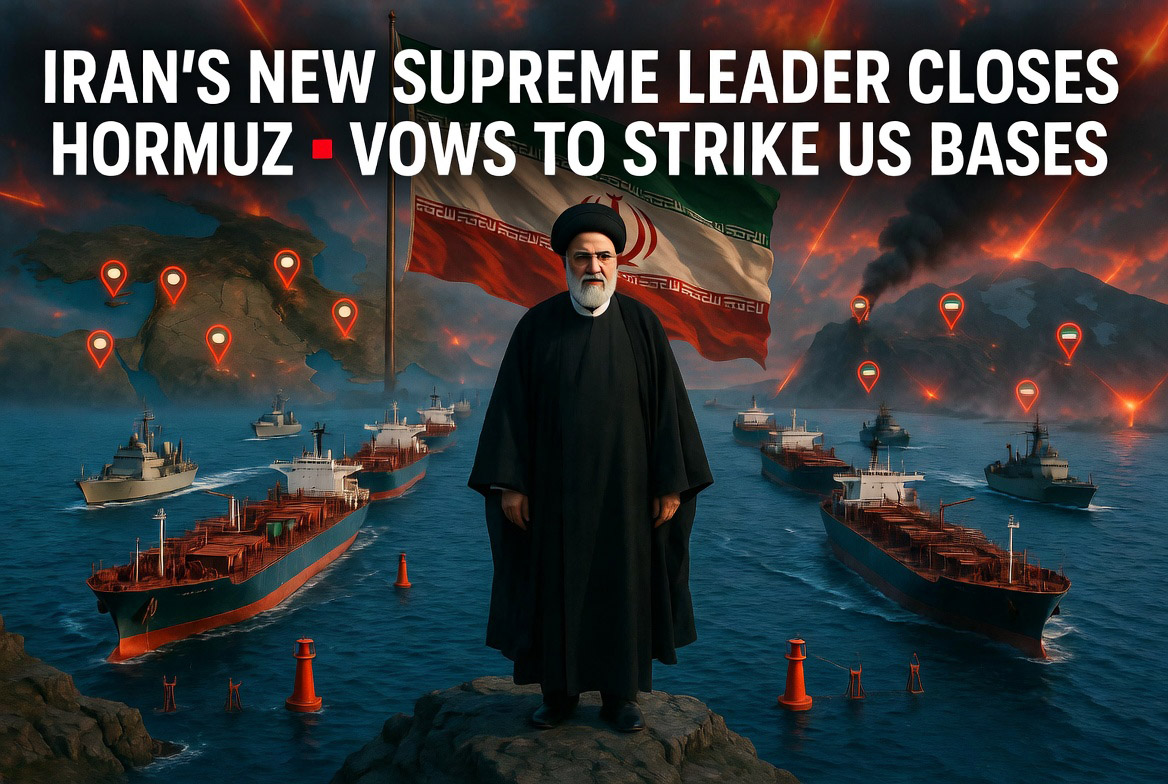
Iran’s newly appointed supreme leader, Mojtaba Khamenei, has delivered his inaugural public message since assuming power following the assassination of his father, Ayatollah Ali Khamenei, and other family members during early strikes by United States and Israeli forces that sparked the current regional war.
In the address, read aloud on state television on Thursday, the younger Khamenei urged Iranians to stand together in the face of adversity. He declared that the Strait of Hormuz—a critical global shipping route—would stay shut as a means to exert pressure on adversaries. He further demanded the immediate closure of all American military installations across the Middle East, warning that failure to comply would trigger direct assaults. Although he emphasized Iran’s desire for amicable ties with neighboring countries, he made clear that operations against those U.S. bases would persist without interruption.
The statement also highlighted support from allied armed factions. Groups in Yemen, he said, stand ready to play their part, while forces in Iraq have expressed eagerness to back the Islamic revolution. Khamenei expressed deep gratitude to Iran’s armed forces for safeguarding the nation’s sovereignty and preventing any fragmentation under heavy assault. He praised the courage of frontline fighters operating amid intense pressure and vowed that the country would press ahead with its defensive campaign.
Ali Khamenei had governed Iran for 37 years before his death in Tehran on February 28. The nation’s Assembly of Experts reached swift agreement on Sunday to name his son as successor.
Observers note that the new leader appears intent on leveraging control of the Strait of Hormuz to escalate tensions rather than seek de-escalation. His firm stance on targeting American bases contradicts recent comments from President Masoud Pezeshkian, who had hinted at possible peace talks if certain conditions were met. Many Iranians remain skeptical about the succession, largely because of persistent economic struggles that triggered widespread unrest late last year and into January. By concentrating on military resistance, the leadership seems to be sidestepping urgent domestic questions about economic recovery, governance reforms, and everyday hardships facing ordinary citizens.
Adding to the uncertainty, the message was not delivered personally by Mojtaba Khamenei, fueling speculation that he may have sustained injuries—or worse—during the ongoing hostilities. This has raised questions about his authority and capacity to guide the country through such a severe crisis.
The remarks are unlikely to align with expectations from U.S. President Donald Trump, who had suggested Iran might follow the example of Venezuela by installing a more compliant figure willing to meet Washington’s terms. Instead, analysts describe the speech as a firm continuation of long-standing Iranian policy, showing no shift in tone or strategy from previous leadership.