
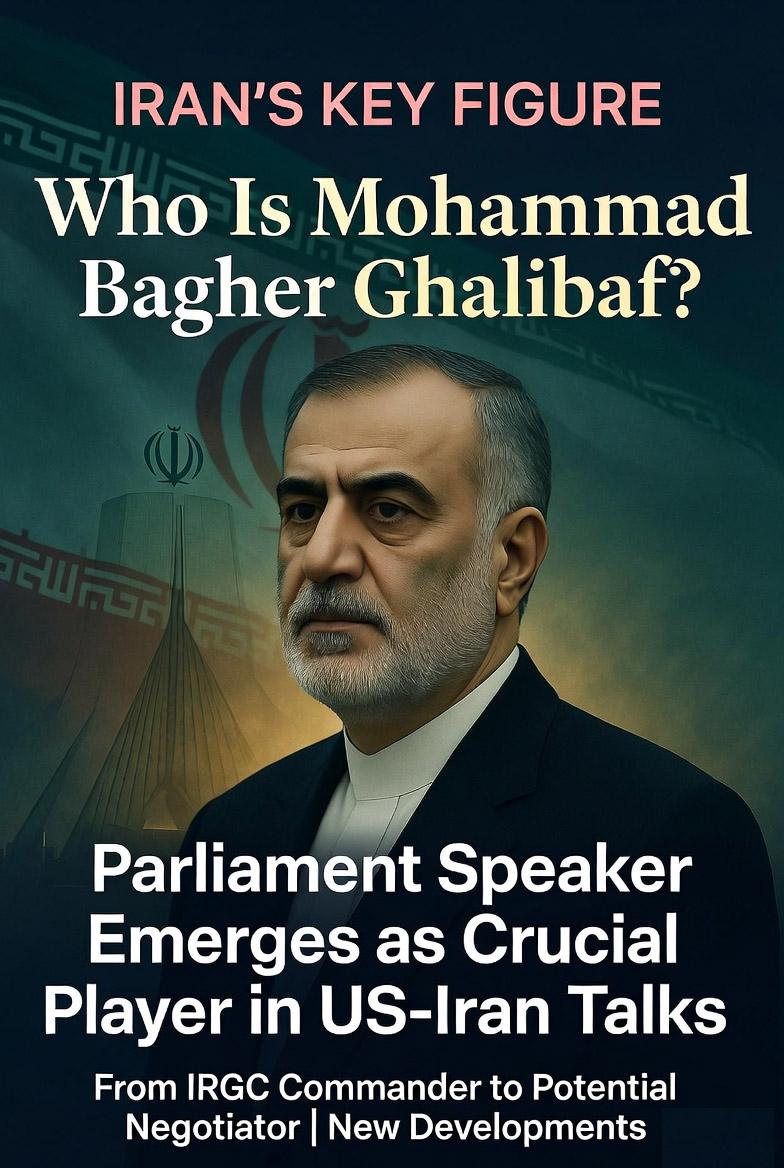
Who Is Mohammad Bagher Ghalibaf and Why Has His Importance Increased?
Mohammad Bagher Ghalibaf is currently the Speaker of Iran’s Parliament (Majlis). According to recent reports, he is playing a highly important role amid the ongoing tensions and indirect talks between Iran and the United States.
- Role in US-Iran Talks: Ghalibaf has been given responsibility for discussions with the United States during the current conflict. Some American officials view him as a practical figure with whom they can engage, despite his strong public statements against Iran’s enemies.
- Removal from Israel’s Hit List: Reports indicate that Israel had planned to target Ghalibaf and Iran’s Foreign Minister Abbas Araqchi. A Pakistani source told one reputed news agency that Pakistan urged the United States to intervene. The message was clear: if these key figures were eliminated, no one would remain to conduct negotiations. As a result, the United States asked Israel to remove them from the target list. Pakistan has been involved in mediating efforts between Iran and the United States.
- Public Stance vs. Pragmatic Image: Ghalibaf, aged 64, has issued strong warnings to Iran’s adversaries. He has threatened continuous attacks if Iran’s territory is threatened and posted messages on X (formerly Twitter) about “constant strikes.” At the same time, some US officials see him as someone they can potentially work with.
Ghalibaf’s Background and Connection to the Islamic Revolution
- Ghalibaf was born in 1961 in Torqabeh, a town near Mashhad in northeastern Iran, into a religious working-class family.
- At the age of 16, he began religious studies in major mosques in Mashhad, including under teachers who later became prominent figures, such as Ayatollah Ali Khamenei.
- Right after the 1979 Islamic Revolution, he joined the fight against Iraq at a young age.
- By age 20, he was associated with the Islamic Revolutionary Guard Corps (IRGC). Two years later, he became commander of one of its combat divisions and served in that role until the end of the Iran-Iraq War in 1988.
- His marriage ceremony was reportedly conducted by Ayatollah Ruhollah Khomeini, the founder of the Islamic Republic. He has three children.
Rise Through the Ranks After the War
- After the war, Ghalibaf continued to advance in the IRGC.
- In 1997, he was appointed commander of the IRGC’s Air Force.
- In 2000, at the age of 39, he became Chief of Iran’s national police force and served for five years. During this period, he introduced a national emergency police hotline and modernized the fleet with foreign vehicles.
Key Positions and Controversies
- Mayor of Tehran: In 2005, after resigning from the police post and losing a presidential bid, Ghalibaf was elected Mayor of Tehran. He served for 12 years — the longest tenure in that position. He is credited with expanding the Tehran Metro and improving infrastructure such as expressways. However, his term faced criticism over high spending and two major issues: the 2016 “Astronomical Properties” corruption scandal (in which city properties were allegedly sold at large discounts) and the 2017 collapse of the Plasco Building, which killed at least 20 firefighters and highlighted administrative negligence.
- Despite these controversies, he faced no impeachment and remained in power.
- Parliament Speaker: In 2020, Ghalibaf won a parliamentary seat and was elected Speaker. He was re-elected to the post in 2024.
Presidential Ambitions and Political Image
Ghalibaf has run for President of Iran four times (2005, 2013, 2017, and 2024), but all attempts were unsuccessful. He initially campaigned on his military background, later presenting himself as a trained pilot, PhD holder in political geography, and a “jihadi manager” — combining loyalty to the revolution with practical management skills.
He is widely seen as close to the IRGC and the Office of the Supreme Leader. While regarded as a conservative hardliner who helped suppress the 1999 student protests, he is also viewed by some as more pragmatic compared to extreme fundamentalists. In recent years, he has had differences with certain hardline factions.
Why His Importance Has Grown Now
In the current war, many senior Iranian leaders have been killed in strikes by the United States and Israel. Ghalibaf’s strengths have become more prominent:
- His close ties with the IRGC.
- Extensive experience across government departments (military, police, municipal administration, and parliament).
- His image as a hardliner who can also act pragmatically.
- His ability to coordinate between the military, senior commanders, and the three branches of government.
These factors have positioned him as a key figure who can help oversee the war effort while potentially participating in high-level diplomatic efforts. His political future may brighten further as Iran stands at a critical juncture.
Note: Ghalibaf has publicly denied holding direct negotiations with the United States, calling some reports “fake news.” However, multiple international sources continue to highlight his emerging central role in any potential dialogue.
This point-by-point explanation covers the key aspects of Mohammad Bagher Ghalibaf’s background, career, controversies, and current significance based on the latest developments.