
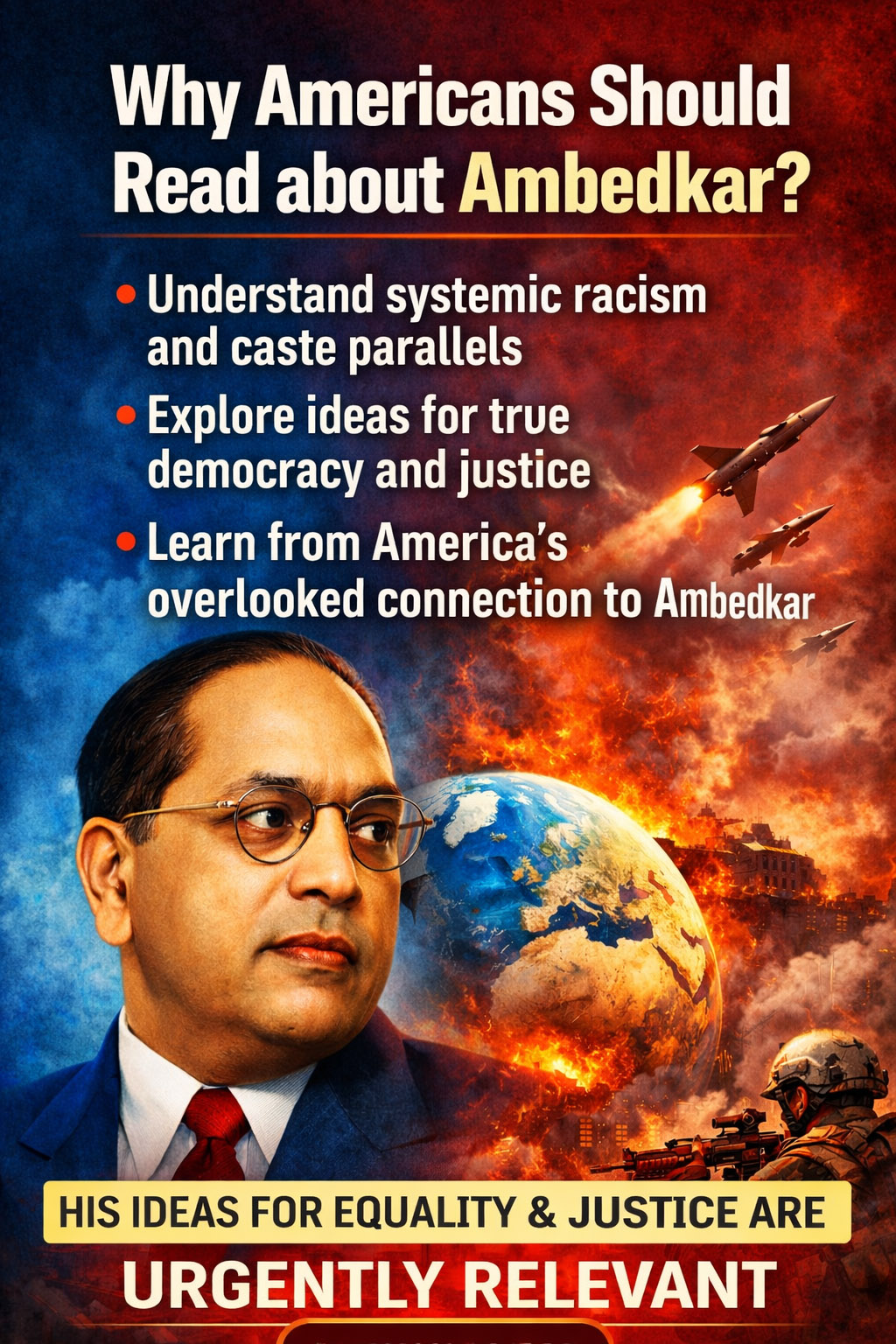
Dr. B.R. Ambedkar: If He Were Alive Today, What Would the Architect of India’s Democracy Say About Our World?
As Ambedkar Jayanti approaches on April 14—marking the 135th birth anniversary of Dr. Bhimrao Ramji Ambedkar—Americans have a timely opportunity to engage with one of the 20th century’s most profound thinkers on equality and justice. Often called Babasaheb (“respected father”), Ambedkar was born into India’s “untouchable” Dalit community in 1891 under British colonial rule. He rose to become the principal architect of India’s Constitution, a brilliant economist, lawyer, social reformer, and the nation’s first law minister. A fierce opponent of caste-based oppression, he championed liberty, equality, and fraternity as the bedrock of any true democracy.
If Ambedkar were alive in 2026, witnessing a world of U.S.-China bipolar tensions, the ongoing U.S.-Israel-Iran war that erupted in February with massive joint strikes on Iranian leadership, nuclear sites, and military infrastructure, continued conflicts in Europe and the Middle East, populist surges, identity-based divisions, and rapid technological change, his perspective would be rooted in the same principles that guided his life: constitutional morality, rational inquiry, and an unyielding commitment to annihilating all forms of inherited inequality—whether caste, race, class, or theocratic domination. He would likely view today’s global politics not through narrow nationalism but as a universal struggle for social democracy, warning that political freedoms crumble without economic and social justice. The current Middle East crisis—with its civilian casualties, disruption of the Strait of Hormuz, retaliatory missile strikes, and fragile two-week ceasefire brokered by Pakistan—would underscore his point that unchecked power and extremism lead to widespread suffering, especially among ordinary people. His lens, forged in part by his deep American connections, would offer sharp, pragmatic insights for our era.
Ambedkar’s Deep Connections to the United States
Ambedkar’s intellectual formation was profoundly shaped by the United States. In 1913, at age 22, he arrived in New York on a scholarship from the Maharaja of Baroda to study at Columbia University—one of the few Indians to pursue advanced degrees there at the time. He earned a master’s in economics in 1915 and began doctoral work, later completing his Ph.D. in 1927 (with an earlier version submitted in absentia). His thesis examined India’s provincial finance under British rule, but his true education came from Columbia’s vibrant intellectual scene.
He studied under John Dewey, whose pragmatism—emphasizing education as a tool for democratic citizenship and social reform—left an indelible mark. Ambedkar later called Dewey one of his “great professors” and credited him with shaping his ideas on equality and rebellion against oppression. He also took courses with economists like Edwin Seligman and anthropologists influenced by Franz Boas, who rejected biological determinism in favor of cultural explanations of difference. Ambedkar lived near Columbia, enjoyed New York life (tennis, dancing, late-night debates), and forged friendships that lasted decades. He even returned briefly in 1931 and received an honorary Doctor of Laws from Columbia in 1952 for his work on human rights.
These years were formative. Exposed to America’s progressive thought and its contradictions, Ambedkar absorbed lessons in democratic experimentation while confronting its racial realities firsthand. His American sojourn equipped him to critique both colonial India and global power structures with clarity and evidence-based rigor.
Ambedkar’s Analysis of Racial Discrimination—Particularly Black-White Issues in America
Ambedkar saw unmistakable parallels between India’s caste system and America’s racial hierarchy. He explicitly compared the plight of Dalits (“Untouchables”) to that of African Americans, arguing that both were systems of graded inequality enforced by custom, law, and violence. In a remarkable 1946 letter to W.E.B. Du Bois, he wrote: “There is so much similarity between the position of the Untouchables in India and of the position of the Negroes in America that the study of the latter is not only natural but necessary.” He had read Du Bois extensively and viewed the “Negro problem” as a mirror to India’s caste problem.
Living near Harlem during his Columbia years, Ambedkar witnessed Jim Crow-era segregation and anti-Black racism up close. He rejected pseudoscientific racial theories of caste (popular among some colonial anthropologists) thanks to Boas’s influence, insisting instead that both caste and race were social constructs designed to perpetuate domination. In works like Annihilation of Caste (1936), he argued that such hierarchies poison society at its root: they deny dignity, block opportunity, and undermine democracy itself.
This analysis was not abstract. When drafting India’s Constitution, Ambedkar drew directly from U.S. models—the Reconstruction-era Civil Rights Acts of 1866 and 1875—to enshrine protections against discrimination, abolish untouchability, and introduce reservations (affirmative action) for Scheduled Castes and Tribes. He saw America’s struggle for racial justice as instructive: progress requires not just laws but a cultural and economic transformation. In 2026, he would almost certainly applaud advances like the Civil Rights Movement’s legacy while critiquing persistent disparities in policing, wealth, education, and incarceration. He might caution against superficial “diversity” rhetoric without structural change, echoing his warning that political democracy alone is hollow without social and economic democracy.
Ambedkar’s Monumental Contributions Across Fields
Ambedkar’s legacy spans disciplines, making him a true polymath. As an economist, his 1923 book The Problem of the Rupee analyzed currency policy and influenced the creation of the Reserve Bank of India. He advocated for industrialization alongside agricultural reform, labor rights, and state intervention to reduce inequality—ideas that prefigured modern development economics.
As a jurist and constitutionalist, he chaired the Drafting Committee of India’s Constitution (1947–49). The document he helped craft remains one of the world’s longest and most progressive: it guarantees fundamental rights, secularism, judicial independence, and affirmative action. He ensured women’s rights, minority protections, and universal suffrage—radical for a newly independent nation.
As a social reformer, he led temple-entry movements, water-access satyagrahas (like the 1927 Mahad march), and ultimately led hundreds of thousands of Dalits to convert to Buddhism in 1956 as a rejection of Hinduism’s caste framework. He founded political parties for Dalits, fought for labor and women’s rights, and wrote over 20 books on history, religion, and politics. His mantra—“Educate, Agitate, Organize”—remains a rallying cry for the marginalized worldwide.
In short, Ambedkar rebuilt India not just legally but morally, proving that one man’s intellect and courage could dismantle centuries of oppression.
Ambedkar’s Likely Stance on Today’s Global Political Landscape
If alive today, Ambedkar would approach 2026’s geopolitics with the same pragmatic realism he applied to India’s foreign policy. He criticized Jawaharlal Nehru’s non-alignment as idealistic and India-centric, instead favoring a strategic, interest-driven approach grounded in national sovereignty, reciprocal diplomacy, and democratic values. He saw foreign affairs as inseparable from domestic justice and pushed for India’s prominent role in global institutions like the UN.
In a bipolar world of U.S.-China “managed coexistence” overshadowed by the ongoing U.S.-Israel-Iran conflict—marked by strikes that killed top Iranian leaders including Supreme Leader Ali Khamenei, Iranian retaliatory missile attacks on Israel and Gulf states, disruption of the Strait of Hormuz causing global fuel crises, and a fragile two-week ceasefire announced on April 7–8 with talks underway in Pakistan—he would express deep concern over the human cost. Thousands dead or displaced, civilian infrastructure damaged, and escalation risks involving Lebanon and Hezbollah would alarm him. He would likely support America’s efforts to curb nuclear proliferation and threats from authoritarian regimes but strongly caution against actions that cause widespread civilian suffering or violate principles of proportionality and international norms. True strength, he would argue, lies in combining military resolve with diplomatic wisdom and post-conflict reconstruction that uplifts ordinary people rather than perpetuating cycles of vengeance.
He opposed imperialism in all forms (British, Soviet, or otherwise) but valued alliances that advance liberty and human rights. A strong U.S.-India partnership based on shared democratic ideals would resonate with him, as would calls for multipolar institutions that prioritize human rights over raw power. He would decry rising populism and majoritarianism anywhere—whether ethnic nationalism in the West, religious extremism fueling proxy conflicts, or theocratic authoritarianism—as threats to constitutional morality.
On identity politics and extremism, he might draw parallels to caste: divisions rooted in birth, religion, or ideology must be addressed through education, economic upliftment, and rational dialogue, not perpetuated by violence. Technological disruption and AI-driven inequality would alarm him; he would demand state socialism elements—welfare, education, and labor protections—to ensure technology serves fraternity, not exploitation.
Climate change, global migration, and the economic fallout from conflicts like the Hormuz disruptions would be moral imperatives: true democracy must address the suffering of the global underclass. Ultimately, Ambedkar would remind us that no superpower is immune to internal decay. As he told India’s Constituent Assembly in 1949: “Political democracy cannot last unless there lies at the base of it social democracy.” The same applies globally, especially amid fragile ceasefires and unresolved tensions in the Middle East.
Why People in the United States Should Read and Understand Ambedkar
Americans should read Ambedkar not as a distant foreign figure but as a vital interlocutor in their own conversations about race, democracy, and justice. His Columbia years and dialogue with Du Bois make him part of America’s story. His insights on turning legal equality into lived dignity speak directly to ongoing debates over affirmative action, systemic racism, and economic populism. In an era of polarization and international conflicts, his emphasis on fraternity—brotherhood across divides—offers a powerful antidote to tribalism and extremism.
Reading Annihilation of Caste, his speeches, or his economic works equips readers to think beyond surface-level reforms or military solutions alone. He shows that education is revolutionary, constitutions are living documents, and democracy fails when it ignores the most marginalized—whether Dalits in India, African Americans, or civilians caught in Middle East wars. For policymakers, scholars, and citizens grappling with global challenges like the Iran conflict, Ambedkar provides a blueprint: pragmatic yet principled, evidence-based yet morally uncompromising.
As we mark his anniversary in 2026, engaging with Ambedkar is more than historical curiosity—it is an act of democratic renewal. In his words and deeds, we find a universal call: build societies where no one is “untouchable,” where liberty and equality are not slogans but realities, and where power serves justice rather than perpetuating suffering. That vision, born in India but tested in America, remains urgently relevant for our shared world.