Iran-US Delegations in Pakistan: What Happened in Islamabad and Why Social Media Is Obsessed with Their Degrees
April 12, 2026 —
In a historic but ultimately inconclusive moment of diplomacy, high-level delegations from the United States and Iran met face-to-face in Islamabad, Pakistan, for the first time since 1979. Pakistan played the role of mediator in talks aimed at salvaging a fragile two-week ceasefire that followed six weeks of devastating U.S.-Israel strikes on Iran. After nearly 21 hours of intense negotiations, the talks ended without a deal on Sunday morning. U.S. Vice President JD Vance, who led the American side, announced that no agreement had been reached and that Iran had rejected Washington’s “best and final offer.”
What Exactly Happened in Islamabad?
The talks were the culmination of frantic Pakistani diplomacy. Pakistan’s Prime Minister Shehbaz Sharif hosted both sides at the Serena Hotel in Islamabad after brokering the initial ceasefire on April 7–8. The U.S. delegation arrived on Saturday morning, led by Vice President JD Vance and including special envoy Steve Witkoff and Jared Kushner (President Donald Trump’s son-in-law). The Iranian side, described by Tehran as a “high-powered” team of at least 70 members, was led by Parliament Speaker Mohammad Bagher Ghalibaf and Foreign Minister Abbas Araghchi. Both delegations met separately with Pakistani leaders before direct talks began.
Key issues on the table included:
- Extending the ceasefire beyond April 22
- Reopening the Strait of Hormuz (which Iran had disrupted, causing global fuel price spikes)
- Iran’s nuclear program and regional proxies (especially Hezbollah in Lebanon)
- Sanctions relief and post-war reconstruction
The marathon session dragged through the night but collapsed over deep disagreements. Vance stated the U.S. had sought a “fundamental commitment” from Iran not to pursue nuclear weapons. Iranian officials, according to state media, accused the U.S. of seeking excuses to exit talks. Pakistan’s Foreign Minister Ishaq Dar urged both sides to honor the ceasefire and pledged to continue facilitating dialogue.
No immediate resumption of major hostilities was announced, but President Trump later indicated the U.S. Navy would begin a blockade of the Strait of Hormuz if needed. The region — and global energy markets — remain on edge.
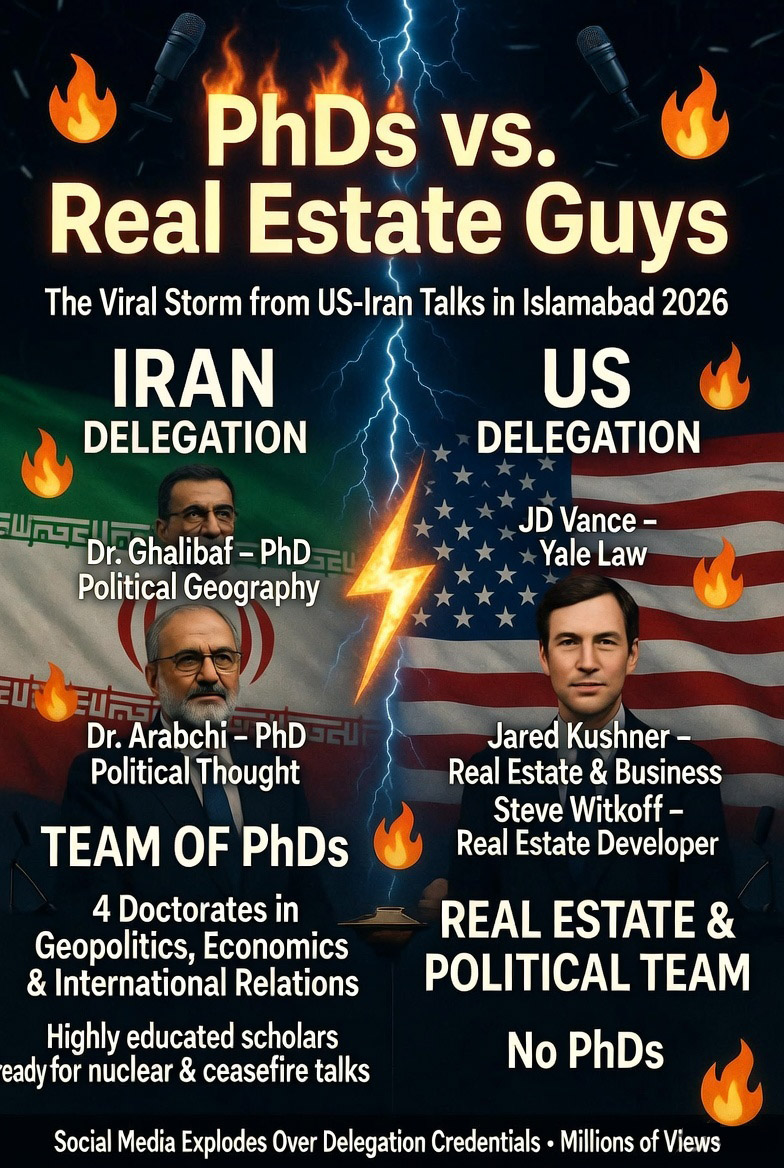
The Viral Social Media Storm: “PhDs vs. Real Estate Guys”
While the diplomatic outcome dominated mainstream headlines, social media (especially X, formerly Twitter) exploded over something else entirely: the educational qualifications of the two delegations.
Within hours of the delegations’ arrival, posts comparing the academic credentials of Iranian and U.S. negotiators went massively viral, racking up hundreds of thousands of views, reposts, and comments. The dominant narrative:
Iranian delegation — portrayed as a team of highly accomplished scholars:
- Multiple senior members, including Parliament Speaker Mohammad Bagher Ghalibaf and Foreign Minister Abbas Araghchi, are referred to as “Dr.” with PhDs (Ghalibaf in political geography; Araghchi in political thought/international relations).
- Other key figures like Dr. Ahmadian and Dr. Hemmat also hold doctorates.
- Broader commentary highlighted that many Iranian officials and even military spokespersons often combine STEM master’s degrees with PhDs in Western philosophy, speak multiple languages (Persian, English, Arabic, Hebrew), and are well-versed in thinkers like Kant, Hegel, and Marx.
U.S. delegation — contrasted sharply:
- JD Vance: Master’s degree (some posts simplify to note he does not hold a PhD).
- Jared Kushner and Steve Witkoff: Described as real estate developers/businessmen with no advanced academic doctorates mentioned.
- Viral memes and graphics declared: “Iran sent 4 PhDs… the US sent none.”
Popular posts included:
- “Iran has taught the world to invest in education. Iran’s 4 delegates to the Pakistan talks have doctorates… US delegates have none.” (Over 10,000 likes and massive reposts)
- “Iranian delegation: All senior leaders hold a PhD. US delegation: Led by Vance and Brad Cooper who both have Master’s degrees. Pakistan team: Led by an FA pass and B.Com pass.” (Hundreds of thousands of views)
- Comparisons to earlier Iranian officials (e.g., a military spokesman with a PhD in Western philosophy and fluency in four languages) to underscore a pattern of deep academic investment.
The contrast became a global talking point. Supporters of Iran framed it as proof of Tehran’s intellectual seriousness and long-term investment in education. Critics of the U.S. approach called the American team “weak, low-IQ negotiators” or “shady real estate developers and Israeli agents.” Others pushed back, arguing that real-world experience in business, politics, and negotiation matters more than academic titles.
Why This Went Viral — And What It Reveals
The education debate tapped into deeper global conversations:
- Soft power and image: Iran used the optics of a highly credentialed delegation to project competence and unity amid war.
- Cultural contrast: It fueled narratives about Eastern emphasis on rigorous scholarship versus Western reliance on political connections and business backgrounds.
- Polarization: In an era of U.S.-Iran hostility, the viral posts became ammunition in broader ideological battles — some celebrating Iran’s resilience, others questioning U.S. diplomatic depth.
Pakistani social media users added a local twist, jokingly comparing their own leaders’ qualifications to the visiting heavyweights.
As the fragile ceasefire holds (for now) and Pakistan offers to host future rounds, the Islamabad talks may be remembered as much for their dramatic failure as for the unexpected global conversation they sparked about who sits at the negotiating table — and what kind of education best prepares a nation for high-stakes diplomacy in 2026.
The world is watching whether cooler heads — and perhaps more doctorates — will prevail before the two-week ceasefire expires on April 22.