
Abu Dhabi — 19 April 2026
In a striking statement that reflects shifting security dynamics in the Gulf, Emirati political analyst Abdulkhaleq Abdulla has asserted that the United Arab Emirates no longer depends on the United States for its defense, citing the country’s performance during recent Iranian attacks.
Speaking to Reuters, Abdulla said the UAE has demonstrated it is “capable of defending itself with distinction” following a wave of missile and drone threats linked to heightened tensions with Iran.
A Turning Point in Gulf Security?
The comments come after a period of escalating confrontation in the region, where the UAE reportedly intercepted multiple aerial threats, including ballistic missiles and drones. The country’s layered air defense systems—developed over years with Western partnerships—played a key role in neutralizing incoming attacks.
Analysts say this moment could represent a turning point in how Gulf nations perceive their reliance on external powers, particularly the United States.
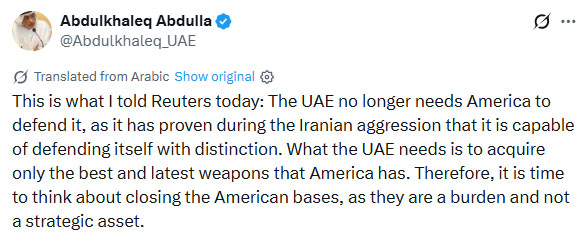
For decades, the U.S. has been the primary security guarantor for Gulf states, maintaining military bases and providing advanced defense systems. However, Abdulla’s remarks suggest that confidence in indigenous defense capabilities is growing.
Building a Self-Reliant Defense Strategy
The UAE has invested heavily in modern military infrastructure, including advanced missile defense systems, cybersecurity capabilities, and domestic defense industries. Joint exercises with allies and real-world operational experience have further strengthened its readiness.
Experts point to several key factors behind this shift:
- Advanced air defense networks capable of intercepting diverse threats
- Rapid response coordination between military and intelligence units
- Strategic diversification of partnerships, reducing reliance on a single ally
This evolution reflects a broader regional trend where countries seek greater autonomy in national security decisions.
Not a Break, But a Rebalance
Despite the strong wording, analysts caution against interpreting the statement as a complete break from Washington. The UAE and the United States continue to share deep military, economic, and intelligence ties.
Instead, this development is better understood as a recalibration of the relationship—from dependence to partnership.
“The message is not that the U.S. is no longer important,” one regional expert noted, “but that the UAE is no longer vulnerable without it.”
Regional Implications
The implications of this shift could be significant:
- It may encourage other Gulf nations to accelerate their own defense independence
- It could reshape the balance of power in the Middle East
- It signals to adversaries that the UAE is prepared and capable of responding decisively
At the same time, it raises questions about the future role of U.S. military presence in the region.